Show original
Try the app

賽ノ河原
Enjoyed this article?
Support oka-project
Share
AI translation
Stacking stones, having them knocked down, and stacking them again. I created a browser game called "Sai no Kawara" inspired by such a motif. At first, there is almost nothing you can do. You stack stones on the riverbed in front of you. That's all. However, as you continue stacking, the situation gradually changes. Statues of Jizo increase, merit accumulates, time flows...
Try the app
賽ノ河原
Enjoyed this article?
Support oka-project
Stacking stones, having them collapse, and stacking again.
I created a browser game called "Sai no Kawara" inspired by this concept.
At first, there's almost nothing you can do. In the riverbed before you, you stack stones. That's all.
However, as you continue stacking, the situation gradually changes. Jizo statues increase, merit accumulates, time flows, and eventually the riverbed becomes something you couldn't have imagined from the initial screen.
 ## What Kind of Game is "Sai no Kawara"?
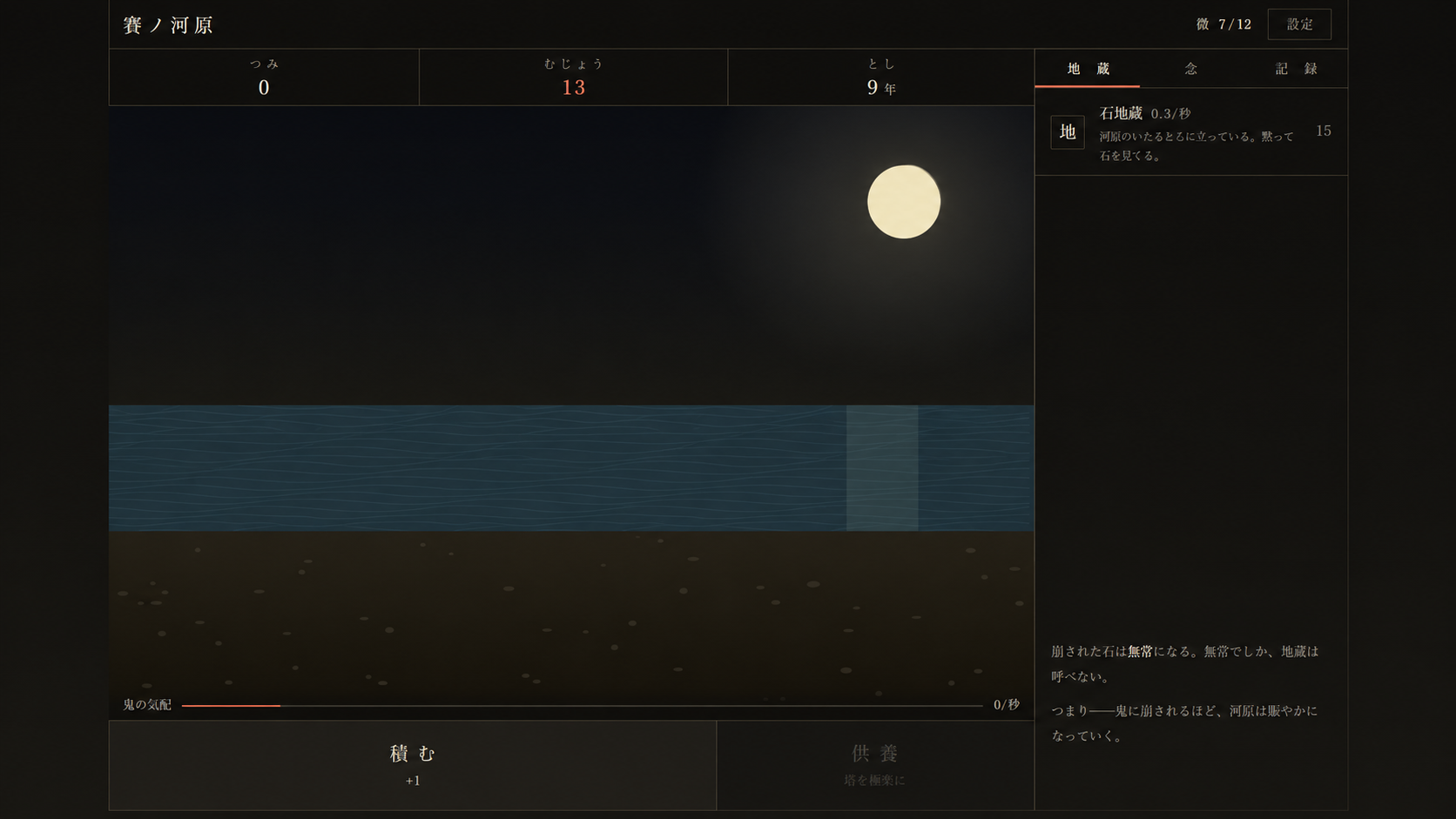
"Sai no Kawara" is a browser game where you continuously stack stones while transforming the riverbed.
Right after starting, the riverbed has almost nothing. When you press "Stack" at the bottom of the screen, stones increase, and from there the game gradually begins to move.
It's not just about increasing numbers—as you progress, new Jizo statues appear and a separate value called "merit" increases. Once you reach a certain point, you'll see choices that weren't available before.
And in this riverbed, time itself flows.
It progresses through 10 years, 100 years, 10,000 years, and continues to time periods you'd rarely see in ordinary games.
 ## Stacked Stones Don't Always Remain Forever
In this game, the stones you've stacked don't remain eternally as they are.
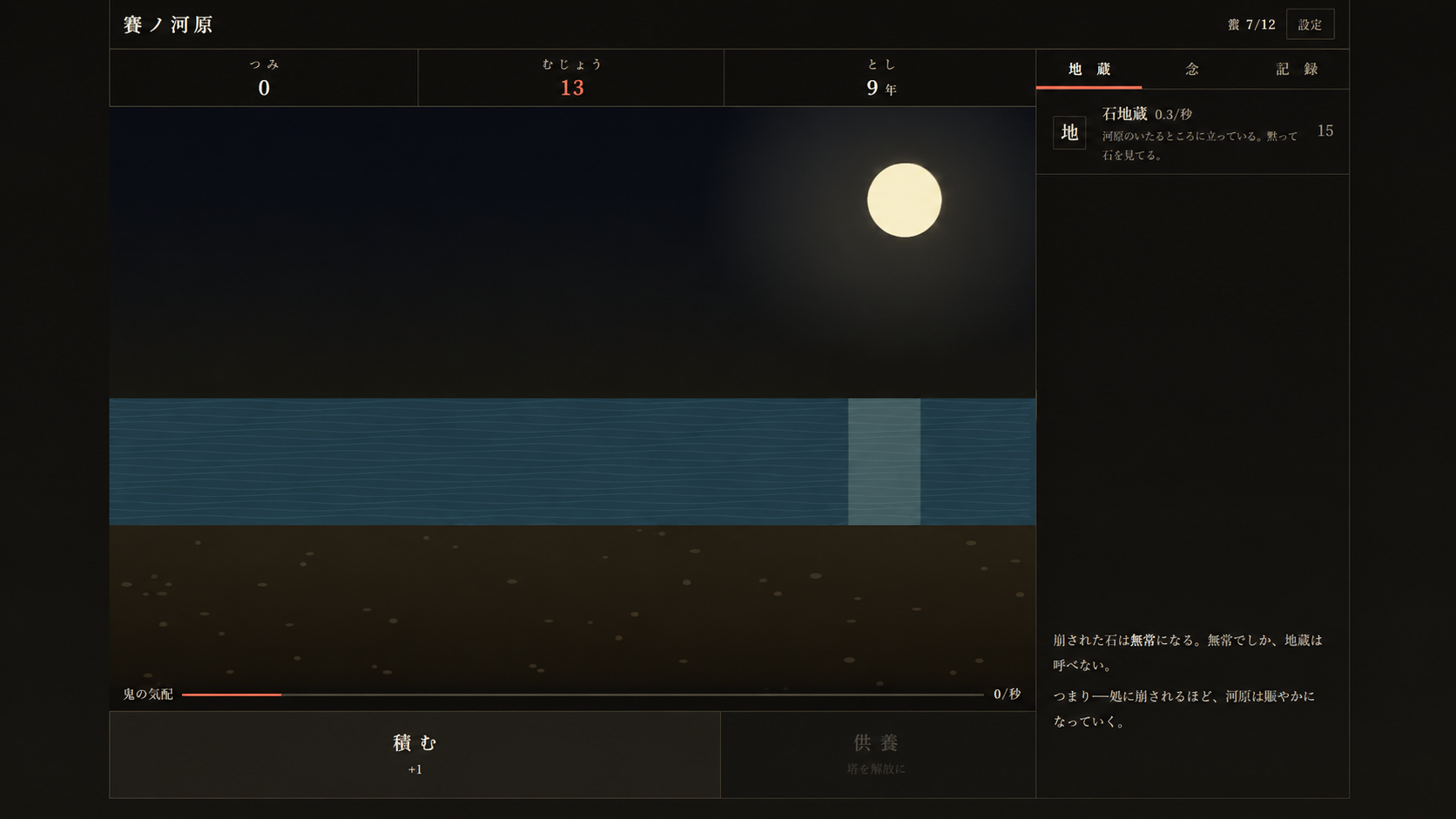
At the bottom of the screen there is "the presence of demons," and the riverbed has a rule that "if collapsed, it becomes impermanence."
There's a possibility that what you've worked to build will be lost. Yet, you stack again.
This "it doesn't end with increasing" is one of the elements I wanted to preserve in creating "Sai no Kawara."
If we only wanted to efficiently increase numbers, we could make a much simpler idle game. However, that would diminish the meaning of using Sai no Kawara as the subject matter.
Both the act of stacking and the loss of what has been stacked exist within the game.
As you continue stacking stones, various Jizo statues appear in the riverbed.
Not just the stone Jizo you see at first, but as you progress, Mizuko Jizo, Enmei Jizo, Rokudo Jizo, and others are unlocked.
Each Jizo has different roles, and changes occur in stone stacking speed and how merit increases.
The riverbed where you initially stacked stones one by one becomes quite different as you progress.
In fact, in this playthrough, the riverbed that had almost no stones in the early stages transforms into a place with tens of millions of stones and numerous Jizo statues when played for a long time.
Observing "how a place with nothing changes" is also one way to enjoy this game.
As you progress through the game, "merit" accumulates separately from stones.
And once you reach a certain point, a mechanism called "samsara" appears.
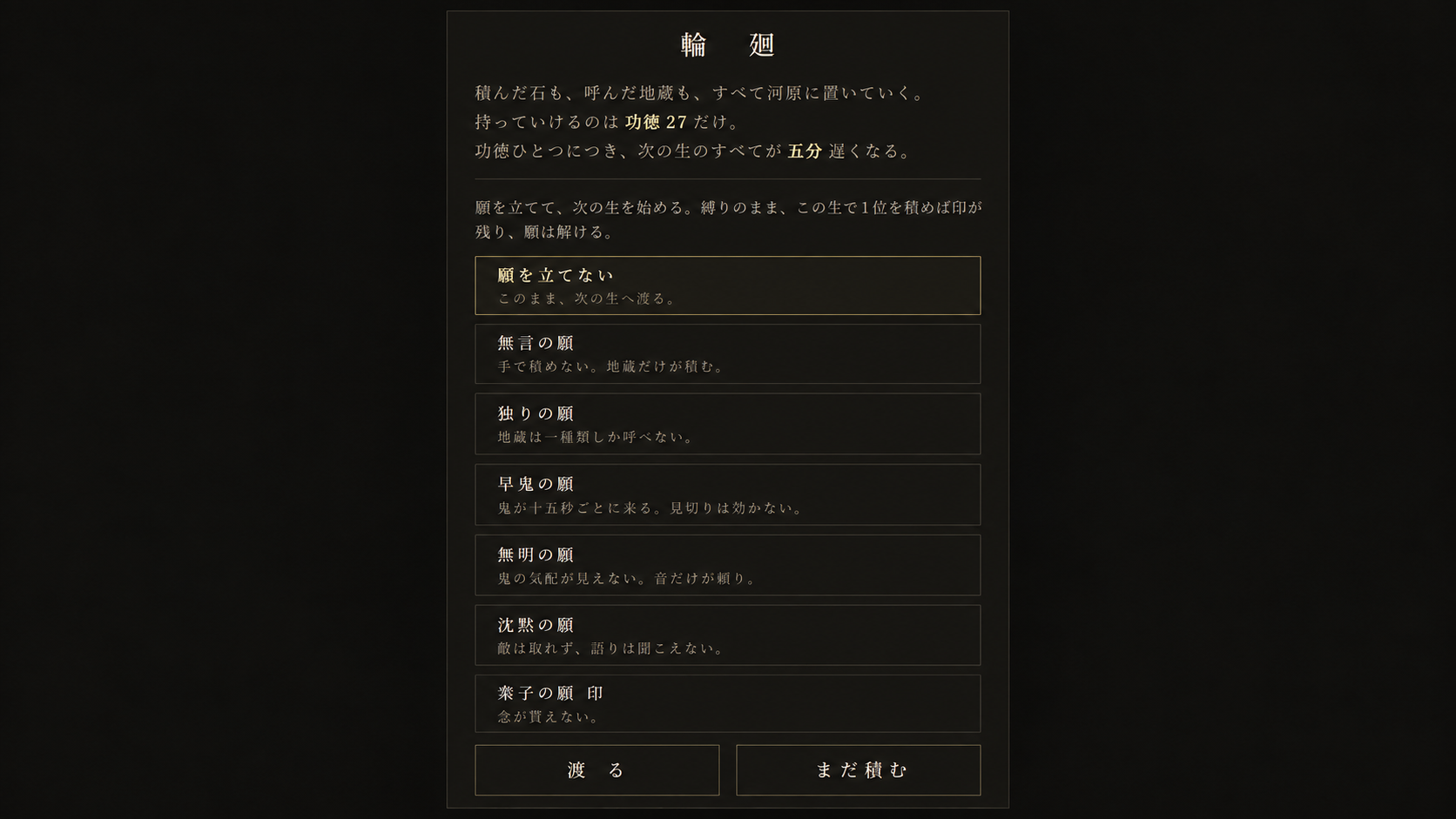 In samsara, instead of maintaining the stones you've stacked and the Jizo statues you've summoned in the riverbed, you can proceed to the next life.
However, what you can take with you and what wishes you choose will affect how things progress afterward.
Rather than a game where you maintain what you've built, there's an option to let go once and move forward. This mechanism is also placed at the center of "Sai no Kawara."
Since explaining the samsara mechanism would become quite lengthy, I plan to detail it in a separate article.
"Sai no Kawara" includes elements that appear under slightly different conditions than normal progression.
For example, names like "Ushi no Koku Mairi," "Bonno," "Tsuki Machi," and "Roku Jizo" exist meaningfully within the game.
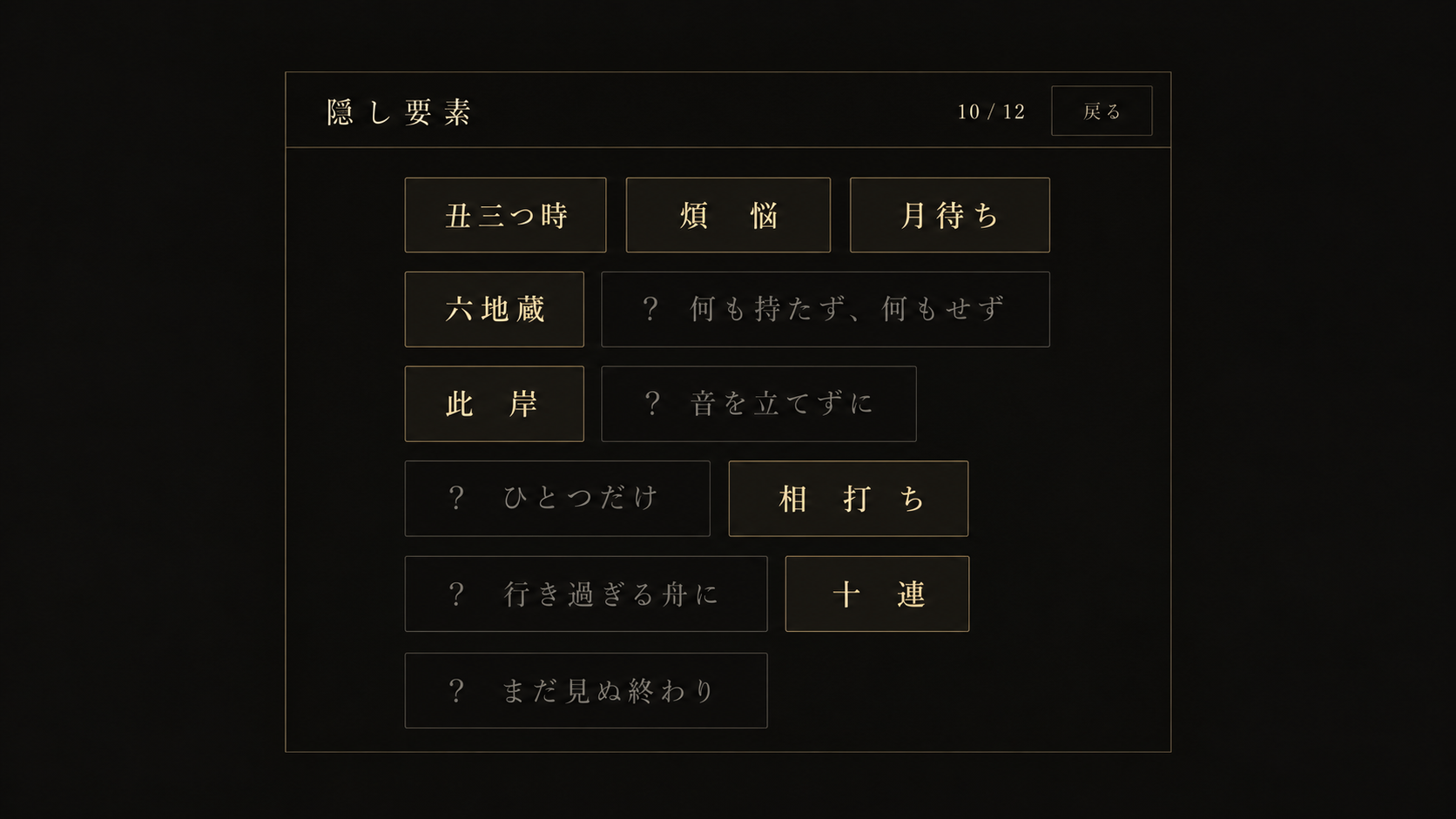 If I revealed all the conditions from the start, there would be no point in searching for them, so I won't write the details here.
Rather than just aiming to increase numbers, I've left parts where you might think "this probably has some condition" and try different actions.
You can enjoy it by progressing normally, but if something catches your interest, try acting differently.
I plan to create a separate article with "hints only" rather than complete answers for the hidden elements.
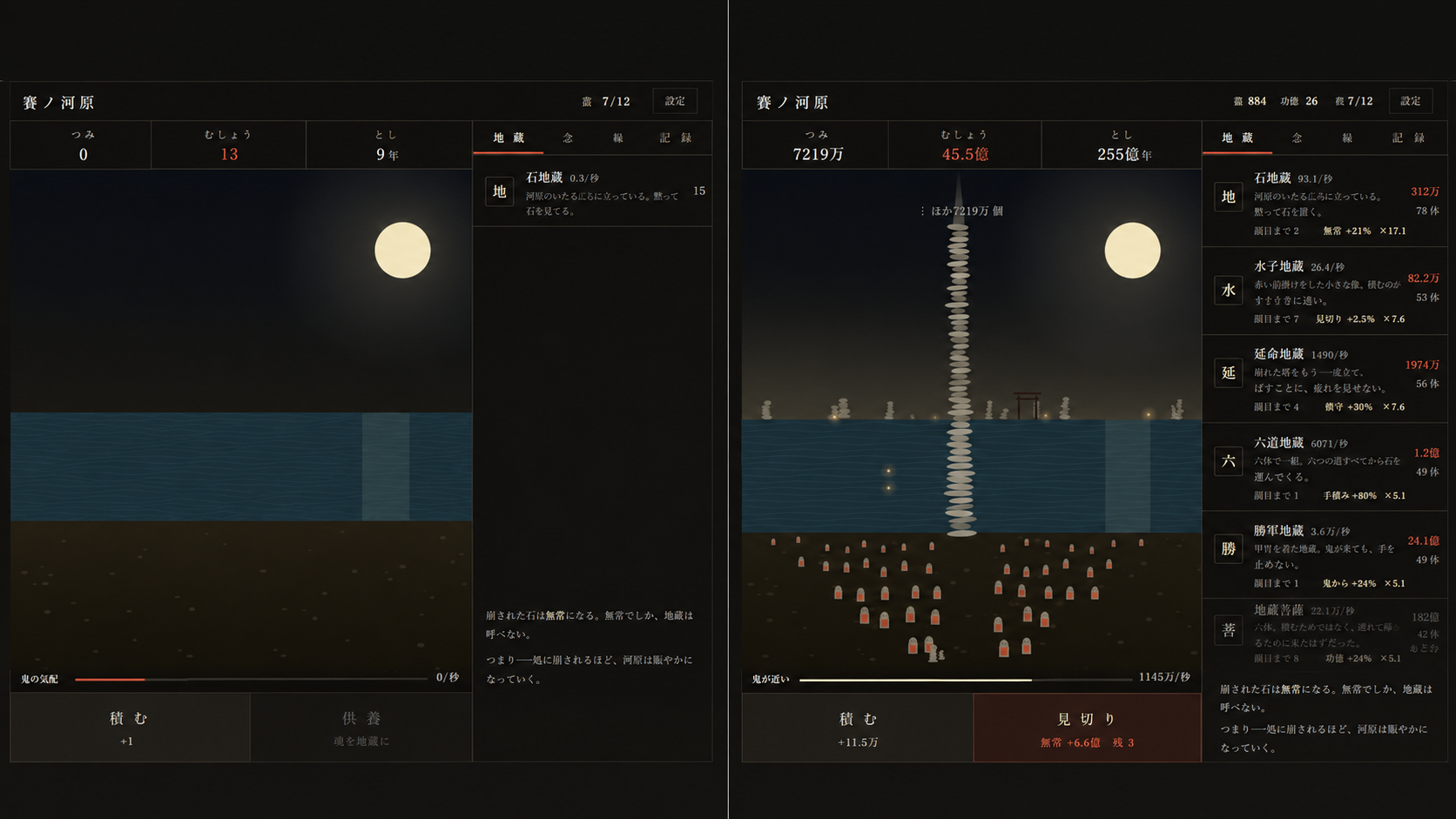
Right after starting, "Sai no Kawara" is quite quiet.
There are almost no stones, no Jizo statues, just the riverbed and the moon.
However, as you play for a long time, the screen fills with massive numbers of stones and Jizo statues, merit values grow large, and elapsed time extends to hundreds of millions of years.
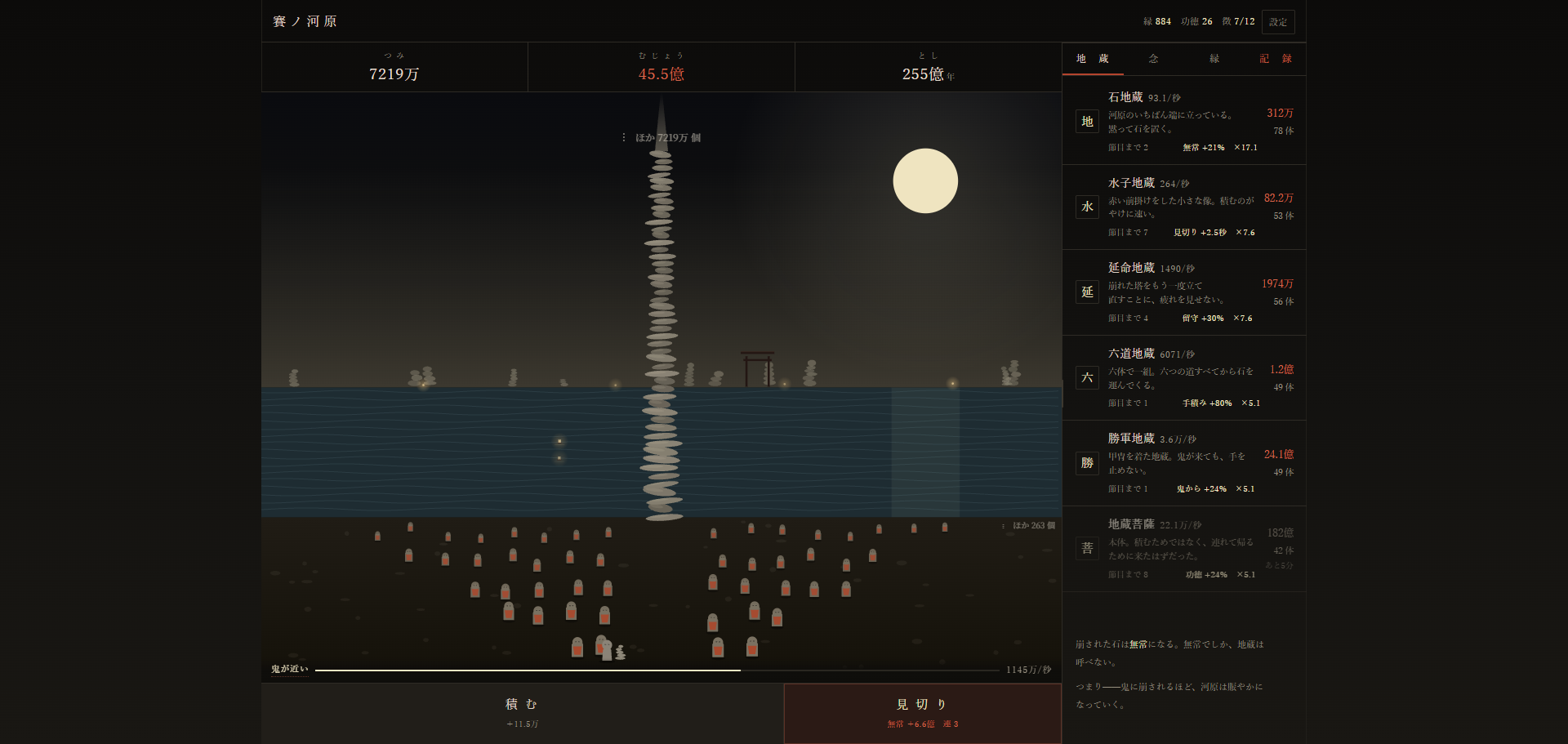 In this playthrough, time progressed to 2.55 billion years.
At this point, the act of "stacking one stone" right after starting and the state where massive things are moving across the entire screen look almost like completely different games.
However, the fundamental thing you're doing hasn't changed.
Stacking stones.
As a result of continuing that endlessly, the riverbed itself transforms.
In the game, you can switch between Japanese and English, Traditional Chinese, Simplified Chinese, and Korean.
Additionally, you can change environmental sound and effect sound volume, effect intensity, and number notation methods from settings.
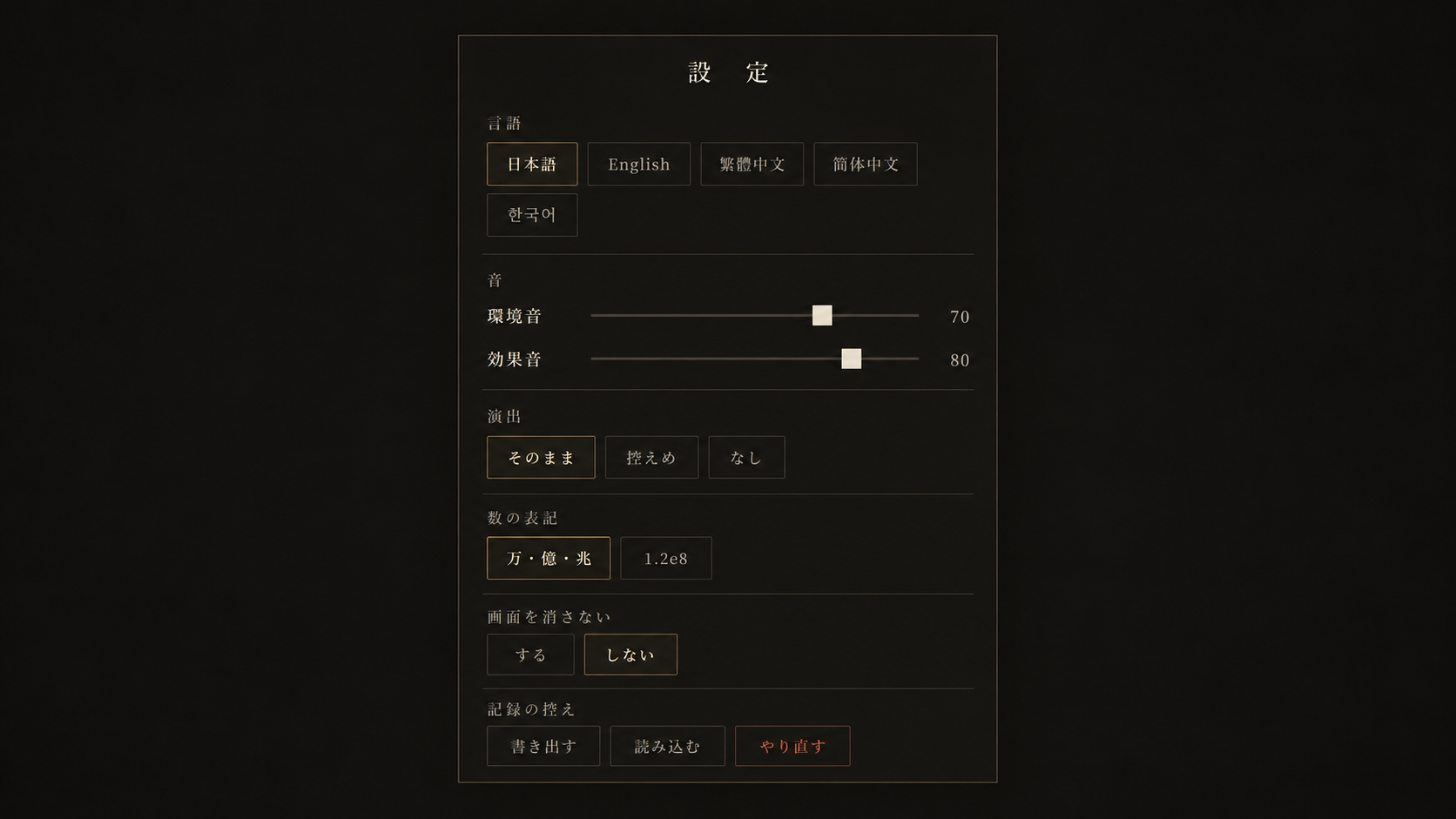 For numbers, you can switch between Japanese notation like "万・億・兆" (man, oku, cho) and exponential notation like "1.2e8."
Since the numbers you handle become quite large in the latter half, I made it possible to change the display method to suit your preference.
For effects, you can choose from normal, subdued, or none. If you're playing for a long time or want to reduce screen shaking, you can change it from settings.
Originally, what I wanted to create was a game based on "the act of stacking itself."
In typical idle games, there's a sense of accomplishment as numbers grow larger. "Sai no Kawara" has that element too, but it also includes mechanisms where stacked things collapse and you let go through samsara.
The subject matter of Sai no Kawara has "stacking" as a straightforward action and "being collapsed despite stacking" as its nature.
From there, it started as a stone-stacking clicking game, and I gradually added mechanisms like Jizo statues, merit, samsara, and long time periods.
As a result, it became a game that's quite simple right after starting, but both the screen and rules change as you progress.
"Sai no Kawara" can be progressed without researching efficiency or strategies from the beginning.
At first, just try stacking stones.
When something is unlocked, check what it does, then stack again. By repeating this, the riverbed that initially had nothing gradually transforms.
I'll gradually compile strategy articles, the samsara mechanism, and hidden elements on Tsukutta.
First, try starting from the empty Sai no Kawara riverbed.
石を積んで、崩されて、また積む。
そんな賽の河原をモチーフにしたブラウザゲーム『賽ノ河原』を作りました。
最初にできることは、ほとんどありません。目の前にある河原で石を積む。それだけです。
けれど、積み続けていると少しずつ状況が変わっていきます。地蔵が増え、功徳が貯まり、時間が流れ、やがて最初の画面からは想像できないような河原になっていきます。
## 『賽ノ河原』はどんなゲーム?
『賽ノ河原』は、石を積み続けながら河原を変化させていく、ブラウザで遊べるゲームです。
スタート直後の河原には、ほとんど何もありません。画面下にある「積む」を押すと石が増え、そこから少しずつゲームが動き始めます。
ただ数字を増やすだけではなく、進めていくことで新しい地蔵が現れたり、功徳という別の値が増えたりします。一定まで進むと、それまでとは違う選択肢も見えるようになります。
そして、この河原では時間そのものも流れていきます。
10年、100年、1万年と進み、普通のゲームではまず見ることのないような時間まで進んでいきます。
## 石を積んでも、ずっと残るとは限らない
このゲームでは、積み上げた石がそのまま永遠に残るわけではありません。
画面の下には「鬼の気配」があり、河原には「崩されれば無常になる」というルールがあります。
せっかく積んだものが失われる可能性がある。それでも、また積み直します。
この「増やして終わりではない」という部分は、『賽ノ河原』を作るうえで残したかった要素のひとつです。
効率よく数字を増やすだけなら、もっと単純な放置ゲームにもできます。ただ、それでは賽の河原を題材にする意味が薄くなります。
積むことそのものと、積み上げたものが失われること。その両方がゲームの中に存在しています。
石を積み続けていると、河原にはさまざまな地蔵が現れます。
最初に見える石地蔵だけではなく、進行に応じて水子地蔵、延命地蔵、六道地蔵などが解放されていきます。
地蔵にはそれぞれ違った役割があり、石を積む速度や功徳の増え方などにも変化が出てきます。
最初は1つずつ石を積んでいた河原が、進行するにつれてかなり違う状態になっていきます。
実際、今回のプレイ画面では、序盤では石がほぼ存在しなかった河原が、長く進めると数千万単位の石と多数の地蔵が存在する場所まで変化しています。
「何もなかった場所がどう変わっていくのか」を眺めるのも、このゲームの遊び方のひとつです。
ゲームを進めていくと、石とは別に「功徳」が貯まっていきます。
そして一定まで進むと、「輪廻」という仕組みが登場します。
輪廻では、これまで積んだ石や呼び出した地蔵などを河原に置いていく代わりに、次の生へ進むことができます。
ただし、そこで何を持っていけるのか、どんな願いを選ぶのかによって、その後の進み方も変わります。
積み上げたものを維持し続けるゲームではなく、一度手放して次へ進む選択肢が存在する。この仕組みも『賽ノ河原』の中心に置いています。
輪廻については仕組みを書き始めるとかなり長くなるので、別の記事で詳しくまとめる予定です。
『賽ノ河原』には、通常の進行とは少し違った条件で現れる要素も入れています。
たとえば「丑三つ時」「煩悩」「月待ち」「六地蔵」など、ゲーム内にはいくつか意味ありげな名前が存在します。
条件を最初から全部公開してしまうと探す意味がなくなるため、ここでは詳細までは書きません。
数字を増やすことだけを目標にせず、「これ、何か条件があるのでは」と考えながら触ってもらえるような部分も残しています。
普通に進めるだけでも遊べますが、気になるものがあれば少し違う行動を試してみてください。
隠し要素については、完全な答えではなく「ヒントだけをまとめた記事」も別途作る予定です。
開始直後の『賽ノ河原』は、かなり静かです。
石もほとんどなく、地蔵もなく、ただ河原と月があるだけです。
ところが長く進めていくと、画面には大量の石や地蔵が並び、功徳の値も大きくなり、経過時間は億年単位まで伸びていきます。
今回のプレイでは、時間は255億年まで進みました。
ここまで来ると、開始直後の「石を1個積む」という行為と、画面全体で大量のものが動いている状態が、ほとんど別のゲームのように見えてきます。
ただ、やっていることの根本は変わっていません。
石を積む。
それをひたすら続けた結果として、河原そのものが変化していきます。
ゲーム内では、日本語のほかにEnglish、繁體中文、简体中文、한국어へ切り替えられるようにしています。
また、環境音と効果音の音量、演出の強さ、数字の表記方法なども設定から変更できます。
数字については「万・億・兆」のような日本語表記と、「1.2e8」のような指数表記を切り替えられます。
後半になると扱う数字がかなり大きくなるため、好みに合わせて表示方法を変えられるようにしました。
演出についても、そのまま・控えめ・なしから選べます。長時間遊ぶ場合や、画面の揺れなどを減らしたい場合には設定から変更できます。
もともと作りたかったのは、「積み上げる行為そのもの」をゲームにしたものです。
一般的な放置ゲームでは、数字が大きくなるほど達成感があります。『賽ノ河原』にもその要素はありますが、それだけではなく、積んだものが崩れたり、輪廻で手放したりする仕組みを入れています。
賽の河原という題材には、「積む」という分かりやすい行為と、「積んでも崩される」という性質があります。
そこから、石を積むクリックゲームとして始まり、地蔵、功徳、輪廻、長い時間という仕組みを少しずつ追加していきました。
その結果、開始直後はかなり単純なのに、進めるほど画面もルールも変化していくゲームになりました。
最初から効率や攻略を調べなくても、『賽ノ河原』は進められるようにしています。
最初は、とりあえず石を積んでみてください。
何かが解放されたら、それが何をするのか確認して、また積む。それを繰り返していくと、最初は何もなかった河原が少しずつ変化していきます。
攻略記事、輪廻の仕組み、隠し要素については、今後Tsukuttaでも順番にまとめます。
まずは、何もない賽の河原から始めてみてください。

