Show original
Try the app

VRChat沼診断
Enjoyed this article?
Support oka-project
Share
AI translation
When playing VRChat, you sometimes hear stories like "I got hooked on world-hopping" or "Before I knew it, I was regularly attending events." Even though people are playing the same VRChat, what appeals to them and what experiences captivate them varies from person to person. On the other hand, for people who are just starting VRChat, figuring out what...
Try the app
VRChat沼診断
Enjoyed this article?
Support oka-project
When playing VRChat, you sometimes hear people say things like "I've fallen into the rabbit hole of world-hopping" or "Before I knew it, I was attending events regularly." Even though everyone is playing the same VRChat, what appeals to each person and what experiences they become absorbed in varies from person to person.
On the other hand, for people who are just starting VRChat, it can be difficult to imagine what kind of enjoyment they might get hooked on.
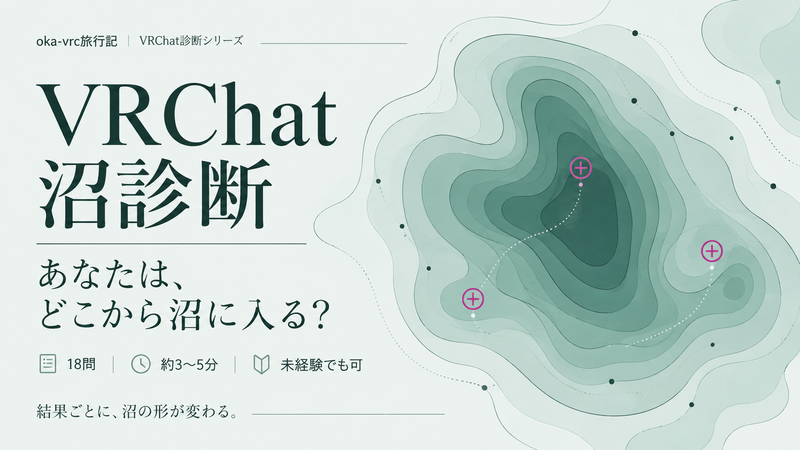
That's why we've now released the VRChat Rabbit Hole Diagnosis.
By answering 18 questions about your everyday behavior and choices, the diagnosis explores the reasons why you become absorbed in things and determines what kind of enjoyment style might suit you in VRChat.
The results display a "rabbit hole map" representing your tendencies, the answers that led to that judgment, and hints about how to enjoy VRChat.
It supports not only Japanese but also English, so you can enjoy it together with friends from overseas.
This diagnosis doesn't just explore simple personality types or your favorite world genres.
For example, some people enjoy finding new places, while others value time spent with people they get along with. Participating in events or finding a comfortable space can be what keeps people playing VRChat.
The VRChat Rabbit Hole Diagnosis focuses not just on "what you enjoy," but also on "why you find it enjoyable."
If you're already playing VRChat, you can compare it with how you normally enjoy the game. If you have little experience yet, it can serve as a reference for finding ways to play that you might want to try.
The diagnosis examines your everyday choices and behavioral patterns through 18 basic questions.
The questions aren't quizzes testing VRChat knowledge, but rather center on how you would act in your daily life.
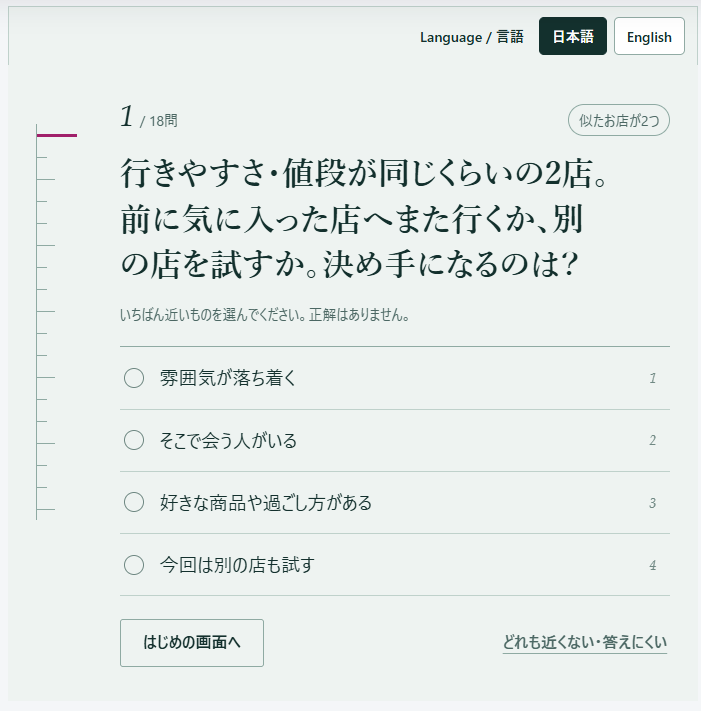
For example, when there are two similar shops, do you choose the one you liked before, or do you try a new shop? Also, what determines your choice of shop—is it the calm atmosphere, the people you'll meet there, or your favorite products?
Through such familiar scenarios, we gradually explore what kinds of experiences tend to appeal to you.
Of course, not all questions have clear-cut answers.
So if none of the options feel close to you, or if it's hard to decide, we've also provided options to indicate that the question is difficult to answer, rather than forcing you to choose one.
During the diagnosis, there's also a presentation where you gradually progress deeper into the rabbit hole as you advance through your answers. The screen layout differs slightly between computers and smartphones, but the structure allows you to check your current progress while answering.
After answering the 18 questions, the results screen appears.
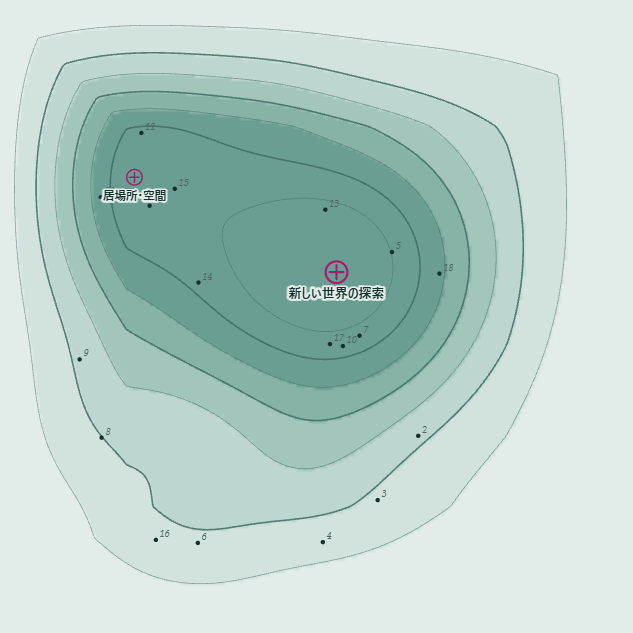
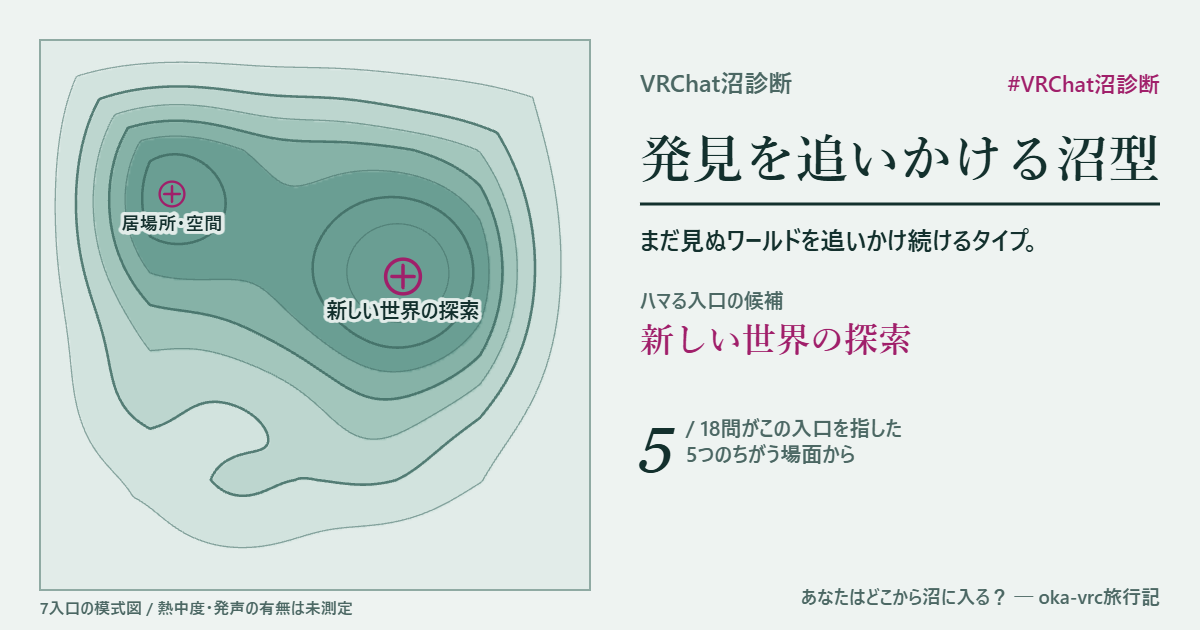
What's distinctive about this diagnosis is that it expresses the tendencies estimated from your answers as a "rabbit hole map."
The results display a type name indicating what kind of reasons might make you absorbed in VRChat, along with visualized tendencies related to 7 entry points.
The diagram reflects markers representing entry point candidates and information about questions that were difficult to answer. Rather than simply classifying you into one type, it also shows what possibilities exist around it.
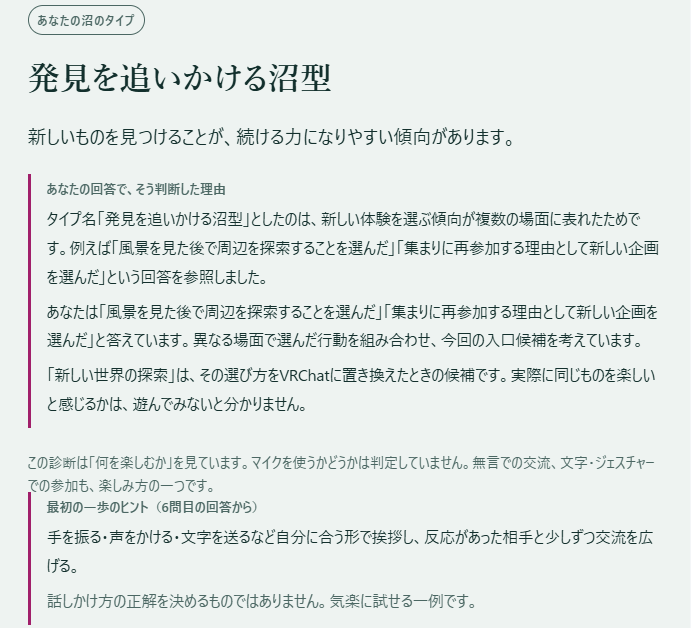
When I actually took the diagnosis myself, my result was "Discovery-Chasing Rabbit Hole Type."
This is a type where finding new places and experiences tends to be the reason for continuing to enjoy the game.
Since I myself continue activities introducing VRChat worlds, seeing the result made me think, "That might actually be true about me."
In the diagnosis results, you can check not just the type name and diagram, but also why that tendency was judged to be strong.
For example, in my results, a tendency to choose new experiences was identified from multiple answers.
Things like wanting to explore the surroundings after seeing a landscape, or choosing to participate in gatherings because there's a new project happening, are shown as the basis for the results.
Additionally, if there were answers in the opposite direction from the main tendency, those are also included in the interpretation.
Rather than deciding everything based on a single answer, the structure explains the results based on what kinds of choices you made across multiple scenarios.
So instead of just being told "you are an ○○ type," there's the enjoyment of reflecting and thinking, "Which of my answers led to this result?"
Of course, the diagnosis results aren't guaranteed to be accurate. We hope you'll enjoy comparing the tendencies visible in your answers with your own experiences.
In addition to the type characteristics, the results screen includes explanations of what kind of enjoyment in VRChat might be a good fit for you.
For example, if you're the "Discovery-Chasing Rabbit Hole Type" like me, it shows a progression where you start by visiting worlds that interest you, gradually become interested in the surrounding areas, and eventually finding new places itself becomes the enjoyment.
You can also check how tendencies visible in your daily life connect to your behavior within VRChat, conditions that make you more likely to get hooked, and parts of your answers that still aren't fully determined.
In the latter half of the results, there are also hints about what you might want to try next.
Even when interacting with others, we don't assume that speaking out loud is the only option. We also consider enjoying VRChat in ways that suit you, such as waving your hand, sending text, or using gestures.
For silent players and listening-only participants, we hope you'll enjoy the game from the perspective of what kind of experiences you tend to enjoy, rather than judging based solely on communication methods.
Your diagnosis results can be shared not just by reading them yourself, but also as an image.
If you show your results to VRChat friends, you might find that you have similar ways of enjoying the game but different types, or discover common ground you weren't previously aware of.
It can also be a chance to introduce the diagnosis to friends by asking, "I got this rabbit hole type, but what about you?"
Since you can switch between Japanese and English, you can have friends who don't use Japanese try it too.
The VRChat Rabbit Hole Diagnosis isn't aimed only at people with extensive VRChat experience.
If you already have a set way of enjoying the game, you can compare the results with your current activities and do an "answer check." If you're just starting out, you can explore directions that might interest you.
For people who have taken a break from VRChat for a while, it might also be an opportunity to think about different ways to enjoy it.
What's displayed in the diagnosis is merely the tendencies that can be read from your answers. There's no "correct" way to play, and you don't have to conform your behavior to a single type.
We'd be happy if you use it to discover ways of enjoying the game you weren't even aware of, or to reconsider why you're currently hooked on something.
This time, I've introduced what the "VRChat Rabbit Hole Diagnosis" is like as content, including the results from actually taking the diagnosis myself.
By answering 18 basic questions, you can explore the reasons you tend to become absorbed and your ways of enjoying, and check the results as a "rabbit hole map." Since detailed explanations and the basis for answers are provided, I hope you'll read through the results carefully even after getting them.
Since it's a free browser-based diagnosis, please try it if you're interested. It might also be fun to share your results with friends and compare the differences.
This time the introduction focused on the diagnosis itself, but why we decided to create content that diagnoses "reasons for getting hooked on VRChat," and how we thought about the questions and results, will be introduced in a separate article.
VRChatを遊んでいると、「ワールド巡りの沼にハマった」「気づいたらイベントに通っていた」といった話を耳にすることがあります。同じVRChatで遊んでいても、何に魅力を感じ、どんな体験に夢中になるのかは人それぞれです。
一方で、これからVRChatを始める人にとっては、自分がどんな楽しみ方にハマるのか、まだ想像しにくい部分もあると思います。
そこで今回公開したのが、VRChat沼診断です。
普段の行動や選択に関する18問に答えることで、あなたが何かに夢中になる理由を探り、VRChatでどんな楽しみ方が合いそうかを診断します。
結果には、自分の傾向を表す「沼の地図」や、その判定につながった回答、VRChatでの楽しみ方のヒントなどが表示されます。
日本語だけでなく英語にも対応しているので、海外のフレンドとも一緒に楽しめます。
この診断で探すのは、単純な性格タイプや、好きなワールドのジャンルだけではありません。
たとえば、新しい場所を見つけることが楽しい人もいれば、気の合う人と過ごす時間を大切にする人もいます。イベントへの参加や、居心地のよい空間を見つけることが、VRChatを続けるきっかけになる場合もあります。
VRChat沼診断では、こうした「何を楽しむか」だけでなく、「なぜそれを楽しいと感じるのか」という部分にも注目しています。
すでにVRChatを遊んでいる方なら、自分の普段の楽しみ方と照らし合わせてみることができますし、まだ経験が少ない方なら、これから試してみたい遊び方を見つける参考にもなると思います。
診断では、基本となる18問を通して、普段の選択や行動の傾向を見ていきます。
質問はVRChatの知識を問うクイズではなく、日常生活の中でどう行動するかを考えるものが中心です。
たとえば、似たようなお店が2つあったとき、以前気に入ったお店を選ぶか、それとも新しいお店を試してみるか。また、お店を選ぶ決め手になるのは、落ち着いた雰囲気なのか、そこで会える人なのか、好きな商品なのか。
こうした身近な場面での選択から、どのような体験に魅力を感じやすいかを少しずつ探っていきます。
もちろん、すべての質問に明確な答えがあるとは限りません。
そこで、選択肢のどれも自分に近くない場合や、判断しづらい場合には、無理に一つへ当てはめず、答えにくいことを示す選択肢も用意しています。
診断中は、回答を進めるにつれて沼の中へ少しずつ進んでいくような演出もあります。パソコンとスマートフォンでは画面の配置が一部異なりますが、現在の進み具合を確認しながら回答できる構成です。
## 診断結果は、あなただけの「沼の地図」に
18問への回答が終わると、結果画面が表示されます。
この診断で特徴的なのが、回答から推定した傾向を「沼の地図」として表現していることです。
結果には、自分がどのような理由でVRChatに夢中になりそうなのかを示すタイプ名とともに、7つの入口に関する傾向が可視化されます。
図には入口の候補を表す印や、答えにくかった質問に関する情報も反映されます。単に一つのタイプへ分類するだけではなく、その周辺にどのような可能性があるのかも見られるようにしています。
自分が実際に回答してみたところ、結果は「発見を追いかける沼型」でした。
新しい場所や体験を見つけることが、楽しみを継続する理由になりやすいタイプです。
自分自身、VRChatのワールドを巡って紹介する活動を続けているので、結果を見て「確かにそういうところはあるかもしれない」と感じました。
## なぜその結果になったのか、回答の根拠も表示
診断結果では、タイプ名や図だけでなく、なぜその傾向が強いと判断されたのかについても確認できます。
たとえば、自分の結果では、新しい体験を選ぶ傾向が複数の回答から読み取られていました。
風景を見たあとに周辺を探索したくなることや、新しい企画があるから集まりに参加するといった選択が、結果の根拠として示されます。
また、主な傾向と反対方向の回答があった場合には、その点も含めて読み解けるようになっています。
ひとつの回答だけですべてを決めるのではなく、複数の場面でどのような選択をしたかをもとに、結果を説明する構成です。
そのため、単に「あなたは○○タイプです」と言われるだけでなく、「自分のどの回答から、こういう結果になったのだろう?」と振り返りながら読む楽しさがあります。
もちろん、診断結果が必ず当たるというものではありません。回答から見える傾向を、自分の経験と照らし合わせて楽しんでもらえればと思っています。
結果画面には、タイプの特徴に加えて、VRChatでどのような楽しみ方につながりそうかという解説も用意しています。
たとえば、自分の「発見を追いかける沼型」であれば、最初は気になるワールドを訪れるところから始まり、次第にその周辺にも興味を持ち、やがて新しい場所を探すこと自体が楽しみになっていく、といった流れが示されます。
そのほかにも、普段の生活で見られそうな傾向とVRChat内での行動のつながり、ハマりやすい条件、回答の中でまだ判断しきれない部分などを確認できます。
結果の後半には、次に何をしてみるとよさそうかというヒントもあります。
誰かと交流する場合でも、声を出して話すことだけを前提にはしていません。手を振る、文字を送る、ジェスチャーを使うなど、自分に合う方法でVRChatを楽しむことも含めて考えています。
無言勢や聞き専の方にも、交流方法だけで判断せず、自分がどのような体験を楽しみやすいのかという視点で遊んでもらえればと思います。
## 結果は画像でシェアできます
診断結果は、自分で読み返すだけでなく、画像として共有することもできます。
VRChatのフレンドと結果を見せ合えば、同じような楽しみ方をしているのにタイプが違ったり、普段は意識していなかった共通点が見つかったりするかもしれません。
「自分はこの沼だったけど、あなたはどう?」と、フレンドに診断を紹介するきっかけにもなります。
日本語と英語を切り替えられるようにしているので、日本語を使わないフレンドにも試してもらえます。
## VRChatを遊んでいる人にも、これから始める人にも
VRChat沼診断は、VRChatの経験が豊富な人だけを対象にしたものではありません。
すでに自分の楽しみ方が決まっている人なら、結果と今の活動を照らし合わせて「答え合わせ」をしてみる。これから始める人なら、自分が興味を持ちそうな方向を探す。
また、しばらくVRChatから離れていた人にとっても、別の楽しみ方を考えるきっかけになるかもしれません。
診断で表示されるのは、あくまで回答から読み取れる傾向です。どの遊び方が正解ということも、ひとつのタイプに合わせて行動しなければいけないということもありません。
自分でも気づいていなかった楽しみ方を見つけたり、今ハマっている理由を改めて考えてみたりする、そんな使い方をしてもらえればうれしいです。
今回は、公開した「VRChat沼診断」がどのようなコンテンツなのか、実際に診断した結果も交えながら紹介しました。
基本となる18問に答えることで、夢中になりやすい理由や楽しみ方を探り、結果を「沼の地図」として確認できます。詳しい解説や回答の根拠も用意しているので、結果が出たあともじっくり読んでもらえればと思います。
無料で遊べるブラウザ診断なので、気になった方はぜひ試してみてください。結果をフレンドと共有して、違いを見比べてみるのも面白いと思います。
今回は診断そのものの紹介が中心でしたが、なぜ「VRChatにハマる理由」を診断するコンテンツを作ろうと思ったのか、設問や結果をどのように考えたのかについては、また別の記事で紹介する予定です。

