Show original
Try the app

NomadGrid — Find Your Next Base
Enjoyed this article?
Support まっちょ
Share
AI translation
Spin a modern UI globe to decide "which city to move to next"
Try the app
NomadGrid — Find Your Next Base
Enjoyed this article?
Support まっちょ
When deciding "which city to move to next," there was too much to research. Living costs on Expatistan, internet speed and safety on NomadList, visas on each country's embassy website, taxes in articles and tax offices... I found myself going back and forth between scattered websites, then trying to piece it all together in my head. That "integration work" felt like the most exhausting part.
Visas and taxes were especially troublesome. "The Schengen area allows 90 days out of 180" and "staying 183 days makes you a tax resident"—the rules are written in articles, but nobody tells you "given my schedule, how many more days can I stay?" You read it and that's the end. NomadGrid was created to change that "read and done" into "calculate and decide."
There are already plenty of beautiful city catalogs to browse in the world. What's missing is a "tool that actually moves decision-making forward" when you use it. So instead of competing on data volume or community size, I focused entirely on decision support: "decide where to go / reduce visa and tax anxiety / translate it into a realistic travel plan." The concept is "a decision-making OS for nomads."
Another motivation was testing how far one person plus AI could build a serious product. I paired with Claude Code from design through implementation, building 100 cities, 4 languages, a globe map, tax/visa calculators, and an AI advisor—all by myself, end-to-end.
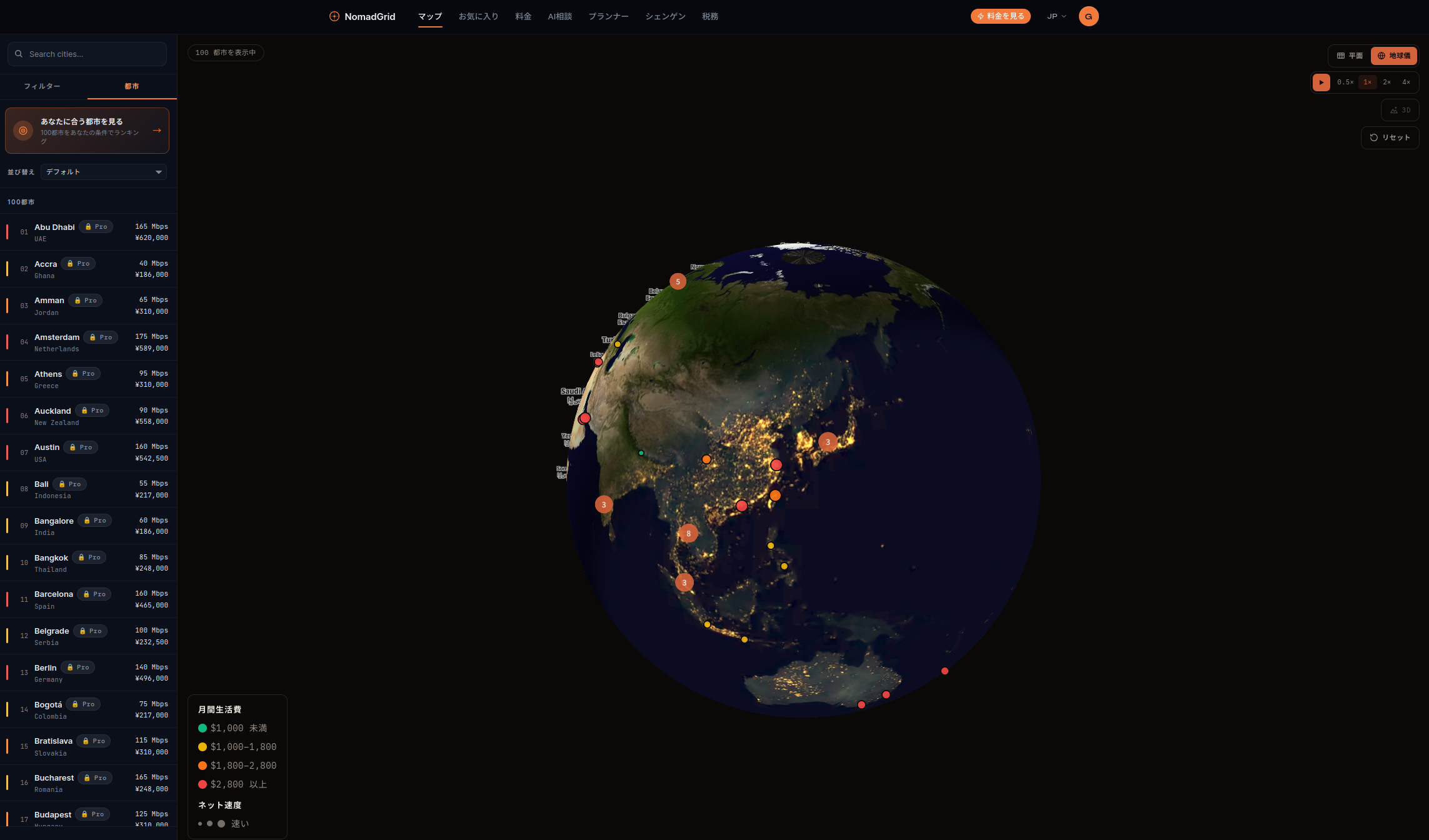
・Globe map to view the world: Switch between flat and globe views with one tap. I obsessed most over the map representation because I wanted people to start with the feeling that "I can go anywhere in the world."
・Real data, not estimates: Climate from 10-year actual averages (Open-Meteo), coworking spaces from OpenStreetMap, living costs from World Bank PPP, summaries from Wikipedia. I replaced placeholder numbers with real API values as much as possible.
・A "calculator," not an "article": Schengen 90/180 days, 183-day tax residency—judged on the spot. Enter dates and get remaining days.
・Honesty: No legal advice. Always show sources and update dates. No inflated numbers like "used by 2,000 people." Reviews are clearly marked as samples. I'd rather be unglamorous but honest than erode trust.
・Details: 4-language translation, contrast (WCAG AA), unified font sizes, light performance even on low-spec devices—I put care into things you don't see.
NomadGrid is still in pre-launch, getting polished a little each day. If you're looking for your next base, start by spinning the globe.
「次にどの街へ移ろうか」を決めるとき、調べることが多すぎました。
生活費は Expatistan、ネット速度や治安は NomadList、ビザは各国の大使館サイト、
税金は記事や税務署…。バラバラのサイトを行き来して、最後は自分の頭の中で全部を
突き合わせる。その「統合する作業」こそが一番しんどい、と感じていました。
特にやっかいなのがビザと税金です。「シェンゲン圏は180日のうち90日まで」
「183日いると税務上の居住者になる」——ルールは記事に書いてあるけれど、
"自分のこの日程だと、あと何日いられるのか" は誰も教えてくれない。
読んで終わり、になってしまう。
NomadGrid は、この「読んで終わり」を「計算して、決められる」に変えたくて作りました。
見て楽しい都市カタログは、もう世の中にあります。
足りないのは "使うと意思決定が前に進む" 道具のほうだと思いました。
だからデータ量やコミュニティの規模で勝負するのをやめて、
「どこに行くか決める/ビザ・税金の不安を減らす/現実的な移動計画に落とす」——
意思決定の支援だけに振り切りました。コンセプトは "ノマドのための意思決定 OS" です。
もうひとつの動機は、個人 + AI でどこまで本気のプロダクトを組み上げられるか
試したかったこと。設計から実装まで Claude Code とペアを組み、100都市・4言語・
地球儀の地図・税務/ビザの計算機・AIアドバイザーまで、一人で通しで作りました。
・地球儀で世界を眺める地図:平面と地球儀をワンタップで切替。「世界のどこへでも
行ける」という気分から始めてほしくて、地図表現に一番こだわりました。
・推測値ではなく実データ:気候は過去10年の実測平均(Open-Meteo)、コワーキングは
OpenStreetMap、生活費は世界銀行 PPP、概要は Wikipedia から。仮の数字を、
できる限り実 API の値へ置き換えました。
・"記事" ではなく "計算機":シェンゲン90/180日、183日税務をその場で判定。
日付を入れれば残り日数が出ます。
・誠実であること:法的アドバイスはしない。必ず出典と更新日を出す。「2,000人が利用」
のような盛った数字は使わない。レビューもサンプルだと明記する。
信用を削るくらいなら、地味でも正直でいたい。
・細部:4言語の翻訳、コントラスト(WCAG AA)、文字サイズの統一、低スペック端末でも
軽い表示まで、見えないところも手を入れました。
NomadGrid は今もプレローンチ中で、毎日少しずつ磨いています。
「次の拠点」を探しているなら、まず地球儀を回してみてください。

