Show original
Try the app

OSS License Chooser
Enjoyed this article?
Support RT2231
Share
AI translation
「とりあえずMIT」の前に。4つの問いで、あなたの公開方針を言葉にする。
Try the app
OSS License Chooser
Enjoyed this article?
Support RT2231
When developing apps and libraries as an individual developer, there's a surprisingly common place where progress stalls at the end. It's the LICENSE file that should go at the end of the README.
MIT, Apache 2.0, GPL, AGPL. You might know the names, but when asked "Is commercial use okay?" "Do you want people to share improvements they make to your code?" or "What about when it's used as a SaaS?" the decision suddenly becomes difficult. Moreover, choosing a license isn't just about deciding on a name. It's about deciding who, to what extent, and under what conditions you want your code to be used.
That's why I created OSS License Chooser—a Japanese-language tool to help individual developers navigate license selection without being overwhelmed by technical jargon.
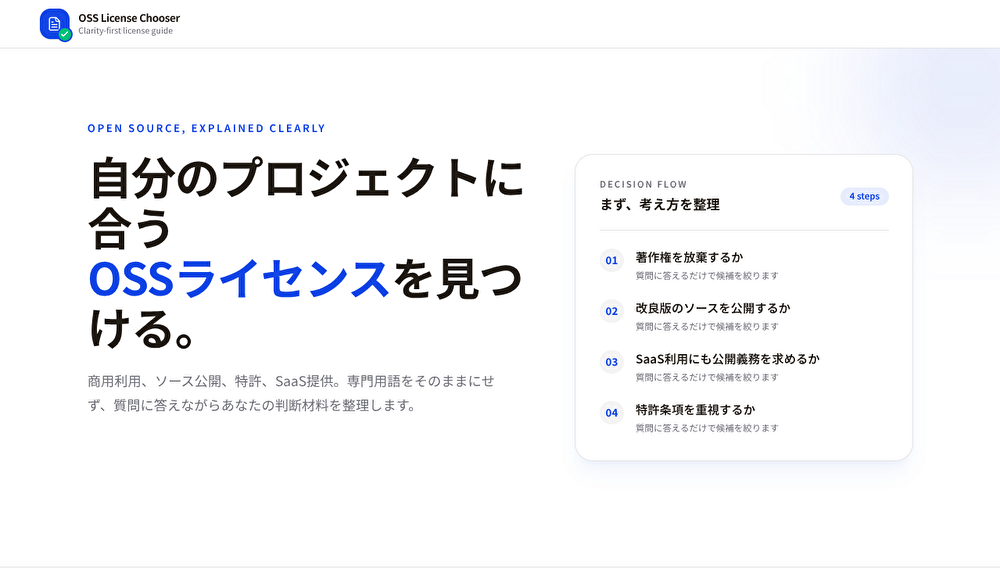
You don't need to read license terms from the start. OSS License Chooser helps you organize your publication policy by answering four questions.
For example: "Do you want to give up copyright as much as possible?" "Do you want improvements to be shared?" "If someone uses it as a web service, do you want them to show you the source?" "Do you care about patent clauses?" The important thing here is not to rush your answers. Before deciding "this license, absolutely," you can separate what you want from what you want to avoid. The diagnosis result is a starting point—you can confirm the reasoning before making your choice.
Simply listing license names doesn't make the actual differences clear. OSS License Chooser lets you compare 12 representative licenses from these perspectives:
Below each column header, there's first a short, easy explanation. Then, hovering over "?" or tapping it on a smartphone shows more detailed explanations about redistribution scope, terminology, and more.
When deciding "MIT or Apache 2.0?" you can focus on what really matters for your project—patent clauses, NOTICE handling—rather than license name recognition.
Once diagnosis and comparison show candidates, open the license details page. For MIT, Apache 2.0, GPL, LGPL, AGPL, BSD, ISC, MPL, EPL, CDDL, and Unlicense, we've organized the perspective beyond just linking to the terms:
Under What you can do, you can check commercial use, modification, redistribution, and private use. Under What you must do, you can check copyright notices, license text, changes, and source provision. We've also summarized patents, trademark/name/logo use, and disclaimers and liability limits as easily-overlooked points before publishing.
The explanation for "when modifying and distributing" is especially important for individual developers. Whether you slightly modify code and publish it on GitHub, distribute it as a built app, or incorporate it into another project—you can check what needs to be kept for each license in each scenario.
OSS License Chooser isn't a tool to automatically produce legal conclusions. Actual decisions depend on license text, dependencies, how code is combined, distribution methods, countries, regions, and more.
Still, there's value in being able to ask yourself before publishing: "Is it okay to permit commercial use with this license?" "Do I want to require modified versions to be shared?" "Have I checked compatibility with dependent libraries?" We want license selection to be a time to organize project policy, not a last-minute task before publishing.
Choosing a license isn't about imposing your views as a developer. It's about deciding in your own words what freedom you want to give users, how much you want to share, and what cautions you want to leave.
If you hesitate in front of the LICENSE file at your next release, start with the four questions. By going back and forth between the comparison table and details pages, you can organize the decision factors that fit your project.
This article introduces general information for license selection. Before publishing or selling, always check the official license text, and for important projects, consider consulting with a specialist.
個人開発でアプリやライブラリを作っていると、最後に意外と手が止まる場所があります。READMEの最後に置くはずの LICENSE ファイルです。
MIT、Apache 2.0、GPL、AGPL。名前は知っていても、「商用利用は許してよいのか」「誰かがコードを改良したら公開してほしいのか」「SaaSとして使われる場合はどう考えるのか」と聞かれると、急に判断が難しくなります。しかも、ライセンスを選ぶことは単に名称を決める作業ではありません。自分のコードを**誰に、どこまで、どんな条件で使ってほしいか**を決める作業です。
そこで作ったのが OSS License Chooser です。個人開発者が、専門用語に振り回されずにライセンス選びを進められるようにするための日本語ツールです。
最初からライセンスの条文を読む必要はありません。OSS License Chooserでは、4つの質問に答えながら、公開方針を整理していきます。
たとえば、「著作権をできるだけ手放したいか」「改良版も公開してほしいか」「Webサービスとして使われる場合もソースを見せてほしいか」「特許に関する条項を重視するか」といった問いです。
ここで大切なのは、答えを急がないことです。「絶対にこのライセンス」と決める前に、自分が望むことと、避けたいことを分けて考えられます。診断結果は出発点であり、その理由を確認してから選べるようにしています。
ライセンス名だけを並べても、実際の違いはつかみにくいものです。OSS License Chooserでは、12種類の代表的なライセンスを、次のような観点で比較できます。
表の項目名の下には、まず短くやさしい説明を出しています。さらに「?」をホバー、またはスマートフォンでタップすると、再配布時の対象や用語の意味など、より詳しい説明を確認できます。
「MITとApache 2.0のどちらがよいか」を考えるときも、名前の知名度ではなく、特許条項やNOTICEの扱いなど、自分のプロジェクトで本当に必要な条件に目を向けられます。
診断や比較で候補が見えたら、次はライセンス詳細ページを開きます。MIT、Apache 2.0、GPL、LGPL、AGPL、BSD、ISC、MPL、EPL、CDDL、Unlicenseのそれぞれについて、単なる条文リンクだけで終わらせず、次の観点を整理しました。
できることでは、商用利用、改変、再配布、プライベート利用などを確認できます。守ることでは、著作権表示、ライセンス本文、変更箇所、ソース提供といった条件を確認できます。さらに、特許の扱い、商標・名前・ロゴの利用、無保証や責任制限についても、公開前に見落としやすいポイントとしてまとめています。
特に「改変して配るとき」の説明は、個人開発では重要です。自分で少し手を入れたコードをGitHubで公開する、ビルドしたアプリとして配る、別のプロジェクトに組み込む。そのどの場面で何を残す必要があるかを、ライセンスごとに確認できます。
OSS License Chooserは、法的な結論を自動で出すためのツールではありません。実際の判断は、ライセンス本文、依存関係、コードの結合方法、配布方法、国や地域などによって変わります。
それでも、公開前に「このライセンスで商用利用を許してよいのか」「自分は改変版の公開を求めたいのか」「依存ライブラリとの組み合わせは確認したか」と問い直せることには価値があります。ライセンス選びを、公開直前の後回し作業ではなく、プロジェクトの方針を整える時間にしたいと考えています。
ライセンスを選ぶことは、開発者としての考え方を押し付けることではありません。利用者にどんな自由を渡したいか、どこまで共有してほしいか、どんな注意を残したいかを、自分の言葉で決めることです。
もし次の公開で LICENSE ファイルの前で少し迷ったら、まず4つの質問から始めてみてください。比較表と詳細ページを行き来しながら、自分のプロジェクトに合う判断材料を整理できます。
この記事はライセンス選択のための一般的な情報を紹介するものです。公開・販売前には必ず公式のライセンス本文を確認し、重要な案件では専門家への相談も検討してください。

